Choosing the right coated steel for roofing, cladding, or industrial enclosures is a critical decision for specifiers and builders. In India’s varied climate—ranging from humid coastal zones to high-altitude Himalayan regions—material performance, cost, and longevity matter. Two commonly used coated steels are PPGL (Pre-painted Galvalume) and PPGI (Pre-painted Galvanized Iron). This guide compares them across manufacturers, corrosion resistance, cost, applications, and selection tips specific to the Indian market.
What are PPGL and PPGI?
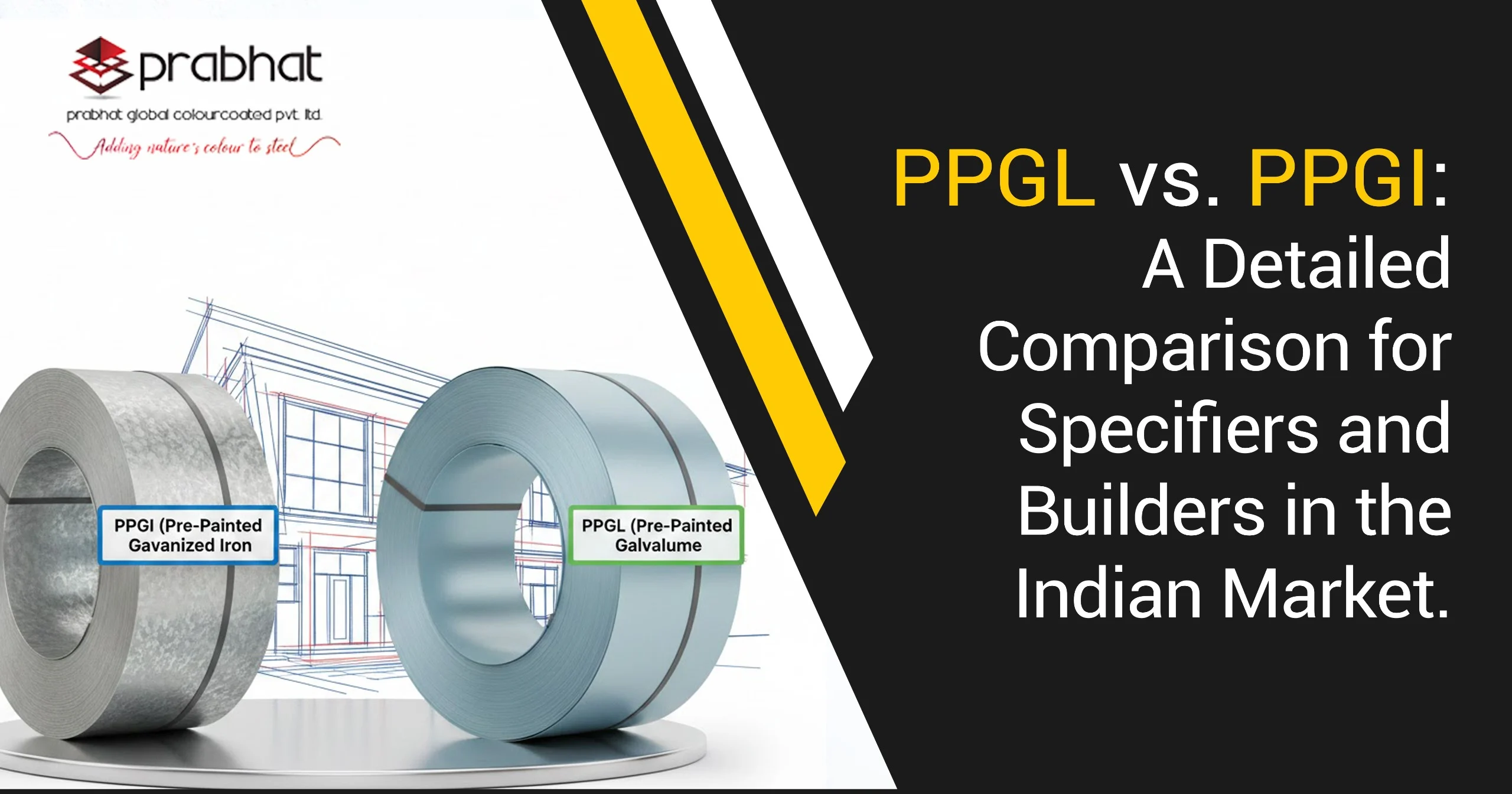
- PPGI stands for Pre-painted Galvanized Iron. It is steel sheet coated with zinc (galvanization) and then finished with paint layers. The zinc layer provides sacrificial protection against corrosion.
- PPGL stands for Pre-painted Galvalume. Galvalume uses a coating made of zinc–aluminium alloy (typically ~55% Al, 45% Zn) applied to the steel, followed by paint. The aluminium component enhances barrier protection and high-temperature performance.
Both products are supplied as coils or sheets, pretreated and painted with factory coatings that improve aesthetics and durability compared to post-painted finishes at the construction site.
Coating & Corrosion Resistance — The Key Difference
The core difference lies in the protective coating:
- Zinc (PPGI): Zinc protects steel by acting as a sacrificial anode. In moderate environments (urban, semi-urban), PPGI performs well. However, in marine or highly humid conditions, zinc corrodes faster than aluminium.
- Zinc-Aluminium (PPGL): The aluminium in Galvalume forms a stable, adherent oxide layer that acts as a barrier. Combined with zinc, Galvalume often delivers superior corrosion resistance, especially against localized corrosion and high temperature oxidation.
In practical terms for India:
- For coastal regions (high salt exposure) and industrial zones (acidic pollutants), PPGL typically outperforms PPGI.
- In inland, low-corrosion locations, PPGI is a cost-effective and reliable choice.
Paint Systems & Aesthetics
Both PPGL and PPGI are offered with various factory paint systems:
- Polyester (PE) — economical, decent color retention for low-exposure projects.
- Silicone Modified Polyester (SMP) — better durability, gloss retention.
- PVDF/Kynar (PVF2) — premium coating with excellent color and chalk resistance, ideal for long-life architectural projects.
Specifiers should match the paint system to project life expectations and maintenance cycles. For commercial façades and exposed roofs in sunny climates, PVDF over PPGL gives the best long-term color stability.
Mechanical & Thermal Performance
- Heat reflectivity: Galvalume (PPGL) has higher reflectivity and emissivity in some finishes, which can help reduce roof surface temperatures—beneficial for energy performance in hot climates.
- Formability: Both PPGL and PPGI coils are readily cold-formed into profiles, although certain premium paint systems require more careful handling to prevent cracking.
- Fire performance: Coatings are thin and do not confer significant fire resistance—structural considerations should be independent of coating choice.
Cost & Availability in India
- PPGI is generally cheaper than PPGL because zinc coatings cost less than zinc-aluminium alloys. Where budgets are tight and the environment is not aggressive, PPGI offers solid value.
- PPGL commands a premium price but can deliver longer service life and lower maintenance costs, often justifying higher upfront expenditure in corrosive environments.
- Availability: Both products are widely available via local coil suppliers, but regional stock may vary. For large projects, confirm lead times and coil spec (coating mass, paint thickness) with suppliers.
Typical Applications
- PPGI: Interior panels, low-exposure roofs, false ceilings, partitions, and budget roofing applications in non-coastal areas.
- PPGL: Exposed roofs, industrial sheds near coasts, cladding for factories and warehouses, and projects requiring longer life with less maintenance.
Selection Checklist for Specifiers & Builders
- Assess the environment: Salt, pollution, humidity, and rainfall rates strongly influence material life. Coastal/industrial = favor PPGL.
- Define expected service life: If 20+ years is required with minimal maintenance, PPGL with a high-quality paint (SMP/PVDF) is recommended.
- Compare total cost of ownership: Factor in maintenance, repainting cycles, and potential replacement costs—not just initial price.
- Confirm coating mass & paint thickness: Look for standardized measures (g/m² for metallic coating, microns for paint). Higher numbers usually mean longer life.
- Specify paint system: For architectural projects, specify PVDF or high-quality SMP for color stability.
- Consider thermal performance: If roof temperature reduction is a factor, check reflectance/emissivity ratings.
- Check warranties & supplier credentials: Insist on manufacturer test data and warranty terms relevant to local climate.
Installation & Maintenance Notes
- Proper installation (correct overlaps, fasteners, and sealants) prevents exposure of uncoated edges and prolongs life for both PPGL and PPGI.
- Avoid contact with dissimilar metals that can create galvanic corrosion.
- Periodic cleaning of roofs in polluted or coastal zones will extend life—removing salt deposits, bird droppings, and industrial grime.
- When cutting or drilling onsite, protect exposed edges by using sealants or edge treatments if long-term corrosion is a concern.
Sustainability & Recycling
Both PPGL and PPGI are based on steel and are highly recyclable at end-of-life, which fits sustainability objectives. Choosing longer-lasting coatings (PPGL + quality paint) reduces material turnover and lifecycle environmental impact.
Conclusion: Which One Should You Choose?
- Choose PPGL when: your project is in a coastal, industrial or high-corrosion area; you need longer service life and lower maintenance; or you prioritize thermal benefits.
- Choose PPGI when: budget constraints dominate, the environment is moderate, and you’re targeting short-to-medium service life with planned maintenance.
For Indian specifiers and builders, the smart approach is to match product to environment and lifecycle expectations, not just initial price. Discuss coating mass, paint system, and supplier warranty up front, and ensure installation teams follow recommended best practices. When in doubt on long-term performance—especially near the coast or in polluted zones—PPGL with a premium paint finish is usually the safer, more economical choice over the structure’s lifespan.